
Your competitive edge in data center cooling
Deliver the uptime, efficiency, and scalability with world-class heat transfer technology you can rely on.
When the stakes are high, you can’t afford to compromise on uptime, efficiency, or scalability. With our advanced cooling infrastructure, you can:
- Increase capacity for AI workloads
- Cut energy use
- Reduce costs
- Boost system reliability
- Meet environmental goals
Understanding data center cooling systems
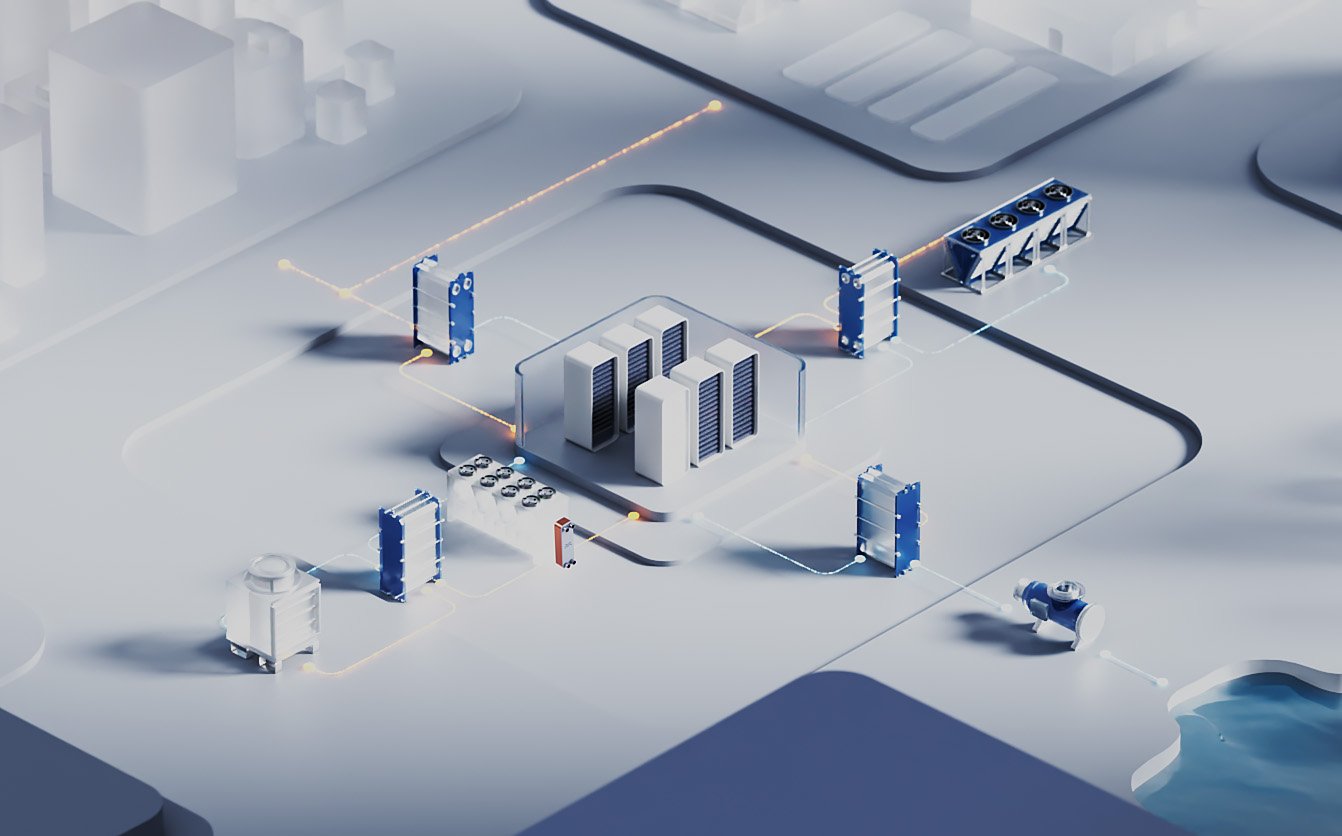
Data centers rely on different methods to manage heat, each with unique advantages:
1. Liquid cooling circulates fluids around CPUs and GPUs for greater efficiency
2. Waterside economizers use cold outside air to chill water for cooling systems
3. Free cooling with air taps into the outside climate to to reduce or eliminate the need for mechanical refrigeration
4. Free cooling with water uses nearby rivers, lakes, or seawater to lower temperatures
A cooling method for every data center
Liquid cooling
Manage heat efficiently with advanced liquid cooling for high-capacity data centers.
Indirect evaporative cooling
Improve efficiency through evaporative heat exchange that minimizes chiller operation.
Free cooling with air
Harness free cooling with air coolers to boost data center efficiency, reduce water consumption and cut energy costs.
Free cooling with natural water
Use natural water sources to cool data centers without consuming water or relying on mechanical systems.
AHRI in Data Centers
Cooling equipment that underperforms can affect server performance, increase energy use, and hurt reliability. That’s why certification matters.
With AHRI-certified equipment, you can save up to 25% in pumping energy and meet heat load targets with confidence.
By easing the strain on chillers, certification helps data centers avoid millions of wasted kilowatt-hours every year.
When big data needs smarter cooling
Data centers consume vast amounts of energy, and Aruba in Italy runs one of the largest in Europe. See how high-performance plate heat exchangers and filters are helping them keep cool while cutting energy loss and shrinking their carbon footprint.
Ready to unlock a smarter energy strategy for your data center?
Cut cooling costs and free up energy for what matters most. See how smart cooling and heat reuse can give your data center the edge you’ve been looking for.
FAQs
How should a facility choose between liquid and free cooling?
Liquid cooling captures server heat, while free cooling addresses heat rejection. They often work together rather than serving as direct alternatives.
Which rack loads should be used to size cooling equipment?
Use peak rack loads and expected growth rather than facility averages alone. Concentrated AI racks require particular attention.
Where does a plate heat exchanger fit into the cooling system?
It transfers heat between separate fluid circuits. The selected location depends on the cooling architecture and facility water arrangement.
When does a waterside economizer reduce chiller operation?
It reduces chiller demand when outdoor conditions provide sufficiently cool water. Available operating hours depend on climate and required supply temperatures.
How should cooling performance be evaluated beyond headline PUE?
Assess actual thermal duty, pumping energy, pressure drop and part-load operation. PUE alone does not explain every cooling system loss.
Why is filtration important when natural water provides cooling?
Filtration helps prevent debris from obstructing heat exchangers. Water quality and fouling risks should inform filter selection and maintenance planning.
How does AHRI certification support equipment evaluation?
AHRI certification provides independent verification of covered thermal performance. Confirm the specific model and operating duty included in the certification.
What should be checked before increasing AI capacity?
Check heat capture, CDU capacity, facility loops and outdoor heat rejection. Every stage needs enough capacity for the planned load.
How should cooling options be compared for lifecycle cost?
Compare equipment, installation, electricity, water and maintenance costs using matching loads. Include expansion and reliability requirements in the evaluation.
Which details help Alfa Laval assess a cooling upgrade?
Provide heat duty, supply and return temperatures, fluid properties and pressure limits. Include operating history and planned workload changes.