
Liquid Cooling for Data Centers
Support AI and high density workloads with smarter cooling for efficient performance.
As power density climbs and energy costs rise, liquid cooling stands out as today’s most effective solution. Key benefits include:
- Deliver more kilowatts per rack
- Reduce reliance on power-hungry chillers, fans, and CRAC/CRAH units
- Maintain safe operating temperatures for CPUs and GPUs
- Reduce energy use by up to 48% and cut operating costs
- Extend equipment lifespan by reducing thermal stress
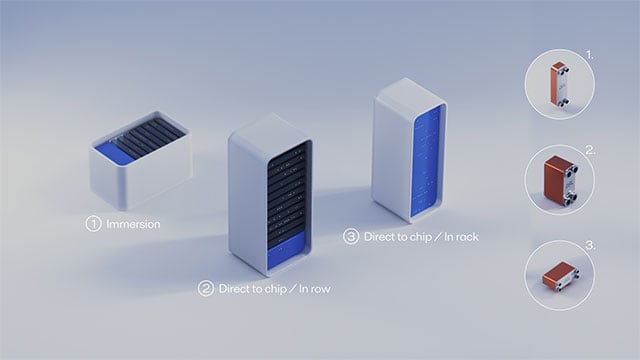
Understanding liquid cooling systems
Liquid transfers heat around 3,000 times more efficiently than air, making it the clear choice for high-capacity data centers. Today’s leading methods include:
- Direct-to-chip cooling runs fluid through cold plates attached to CPUs and GPUs, carrying heat away via a Coolant Distribution Unit (CDU).
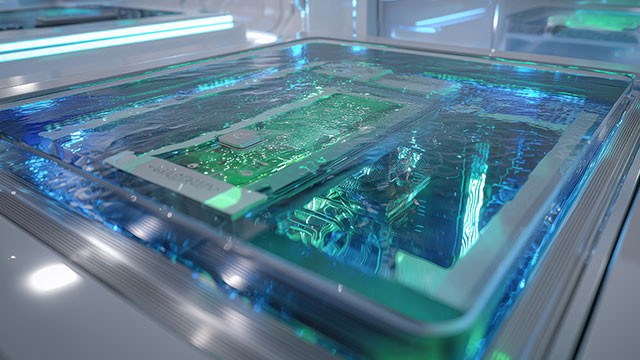
- Immersion cooling places servers in non-conductive fluid, allowing maximum heat transfer and easier thermal management. This method is also called open bath cooling.
Direct-to-Chip Cooling
Boost performance and cut costs by cooling CPUs and GPUs directly at the source.

Immersion Cooling
Maximize efficiency by submerging servers and chips in non-conductive fluid.
Cooling the AI revolution
Boyd, partnering with Alfa Laval’s heat exchanger expertise, developed a breakthrough in-row coolant distribution unit (CDU) with unmatched capacity. Compact yet powerful, it delivers up to 2.3 MW of cooling, empowering data center owners and operators to scale AI with confidence.

Ready to keep pace with AI demand?
AI-driven demand is here to stay. Let us help you stay ahead with smarter liquid cooling that boosts capacity, improves efficiency, and eases the strain on supporting cooling systems.
FAQs
When should an AI facility consider liquid cooling?
Consider it when concentrated CPU or GPU heat challenges the existing air system. Assess server compatibility and facility infrastructure before selecting an approach.
How do direct-to-chip and immersion cooling differ operationally?
Direct-to-chip systems cool processors through attached cold plates. Immersion systems place servers in dielectric fluid and manage heat across the equipment.
What does a CDU contribute to a liquid cooling installation?
A coolant distribution unit manages heat transfer between the technology and facility loops. Its capacity and controls must match the IT cooling requirements.
Does liquid cooling always require a new facility water system?
Requirements depend on the CDU and heat rejection arrangement. Review existing water capacity, piping and temperature limits before planning a retrofit.
What should be checked before converting an air-cooled facility?
Check liquid-ready servers, piping routes, floor loading and available heat rejection. A phased hybrid arrangement suits many mixed-workload facilities.
Why does liquid cooling create opportunities for heat reuse?
It captures heat in a fluid circuit close to the source. Reuse suitability depends on return temperatures and nearby heating demand.
How should the page's energy-saving figures be interpreted?
Treat them as potential outcomes under specific conditions. Estimate project savings from the complete design and actual operating profile.
How does backflushing support cooling system maintenance?
Reversing water flow helps dislodge accumulated debris. The arrangement and schedule should suit the exchanger and incoming water conditions.
Does AHRI certification replace system commissioning checks?
No. Certification verifies covered equipment performance, while commissioning checks the complete installation against its operating and design requirements.
Which support areas are described beyond equipment supply?
The page describes design guidance, installation support, operator training, troubleshooting and maintenance, including customized cleaning protocols.
What should be reviewed before choosing a cooling system upgrade?
Review current temperatures, flow rates, fouling history and expected loads. Include filtration, cleaning access and service requirements in the upgrade scope.