
Immersion cooling for high-capacity data centers
As energy demands rise, immersion cooling provides uniform thermal performance, improved efficiency, and supports higher-density computing.
Data centers worldwide have adopted immersion cooling due to its scalability, thermal stability, and support for high-performance computing. Advantages include:
- Eliminate hot spots for uniform thermal performance
- Operate at higher temperature tolerances
- Lower PUE (Power Usage Effectiveness) and CUE (Carbon Usage Effectiveness)
Thermal management across the entire system
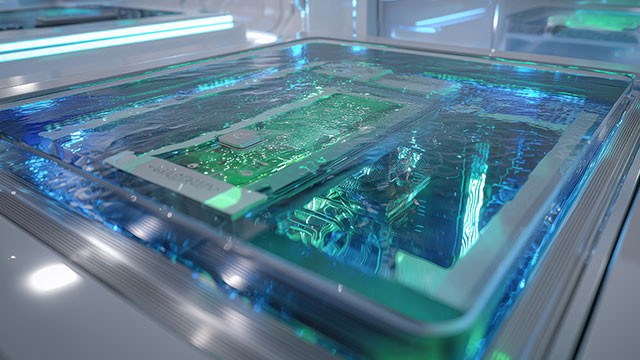
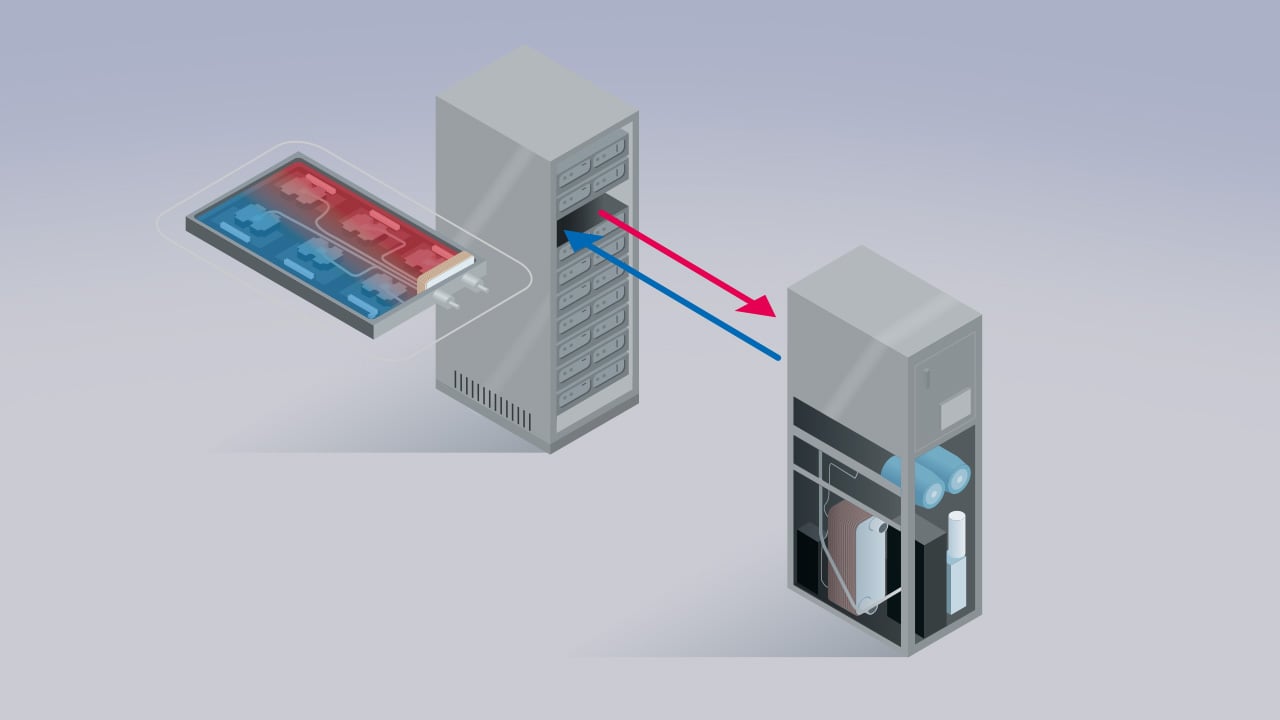
Immersion cooling works by submerging servers in a dielectric fluid. The liquid surrounds the entire system, eliminating hot spots and efficiently transferring heat from all components. The heated liquid is circulated to a heat exchanger, cooled, and returned to the tank, offering one of the most thermally effective solutions for high-density data centers.
Methods of immersion cooling
Immersion cooling can be deployed in different ways, each offering distinct advantages based on density, efficiency goals, and operating requirements.
Single-phase immersive IT chassis
Servers are installed in a sealed chassis filled with dielectric fluid. Heat is absorbed by the fluid and carried to a heat exchanger without changing state. This method:
- Provides consistent cooling across all components
- Handles moderate to high-capacity workloads
- Simplifies integration for rack-based deployments
Single-phase immersive tub
Entire racks of servers are submerged in a tank of dielectric fluid. Heat is absorbed and circulated out for removal, keeping performance steady. This method:
- Cools large groups of servers at once
- Reduces reliance on fans and CRAC units
- Enables easier maintenance with accessible, rack-level design
Two-phase immersive tub
Servers are submerged in a dielectric liquid that evaporates into vapor as it absorbs heat. The vapor then condenses back to liquid in the heat exchanger. This method:
- Removes more heat through phase change
- Manages extreme AI and HPC workloads
- Delivers maximum efficiency
Ready to switch to liquid cooling?
Let us guide your transition with advanced solutions that unlock the highest performance for high-capacity AI and machine learning environments.
FAQs
When does immersion cooling merit consideration for AI workloads?
Consider it when high-density equipment needs extensive heat capture. Evaluate hardware compatibility, fluid selection and maintenance arrangements together.
How does an immersed chassis differ from an immersion tub?
A chassis contains servers within a sealed fluid-filled enclosure. A tub immerses groups of equipment in a larger tank.
How does single-phase immersion remove heat from servers?
Dielectric fluid absorbs heat without changing state. A heat exchanger removes the captured heat before the fluid returns to the equipment.
What changes in a two-phase immersion installation?
The dielectric liquid evaporates as it absorbs heat and then condenses. Equipment and fluid selection must suit that operating process.
Why is dielectric fluid compatibility important for immersion cooling?
The fluid contacts server components directly. Compatibility with hardware, seals and heat exchanger materials needs confirmation before deployment.
What should operators assess before installing immersion tanks?
Assess floor loading, available space, fluid handling and maintenance access. Check how the tanks connect to the facility heat rejection system.
Does immersion cooling remove the need for heat exchangers?
No. Captured heat still needs transfer to a cooling or reuse circuit through an appropriate heat exchanger arrangement.
How should immersion cooling maintenance be planned?
Plan safe equipment access, fluid management and servicing procedures around the selected tank or chassis design and hardware requirements.
How should single-phase and two-phase immersion options be compared?
Compare thermal loads, equipment compatibility, operating complexity and service practices. Select the arrangement that fits the facility's requirements.
What determines an immersion system's heat reuse potential?
Fluid operating temperatures and the heat exchanger arrangement influence reuse. Nearby heat demand and delivery temperatures determine practical value.