
Direct-to-chip cooling for high-performing data centers
When AI pushes processors to their limit, direct-to-chip liquid cooling delivers precise thermal control right where it counts.
The ultimate protection for CPUs and GPUs starts with cooling at the core. With direct-to-chip cooling, you can:
- Enable higher density servers
- Build capacity for AI and machine learning
- Save on operating costs
- Extend the lifespan of hardware with reduced thermal stress
- Unlock opportunities for heat reuse
- Lower PUE (Power Usage Effectiveness) and CUE (Carbon Usage Effectiveness)

Thermal management at the chip level
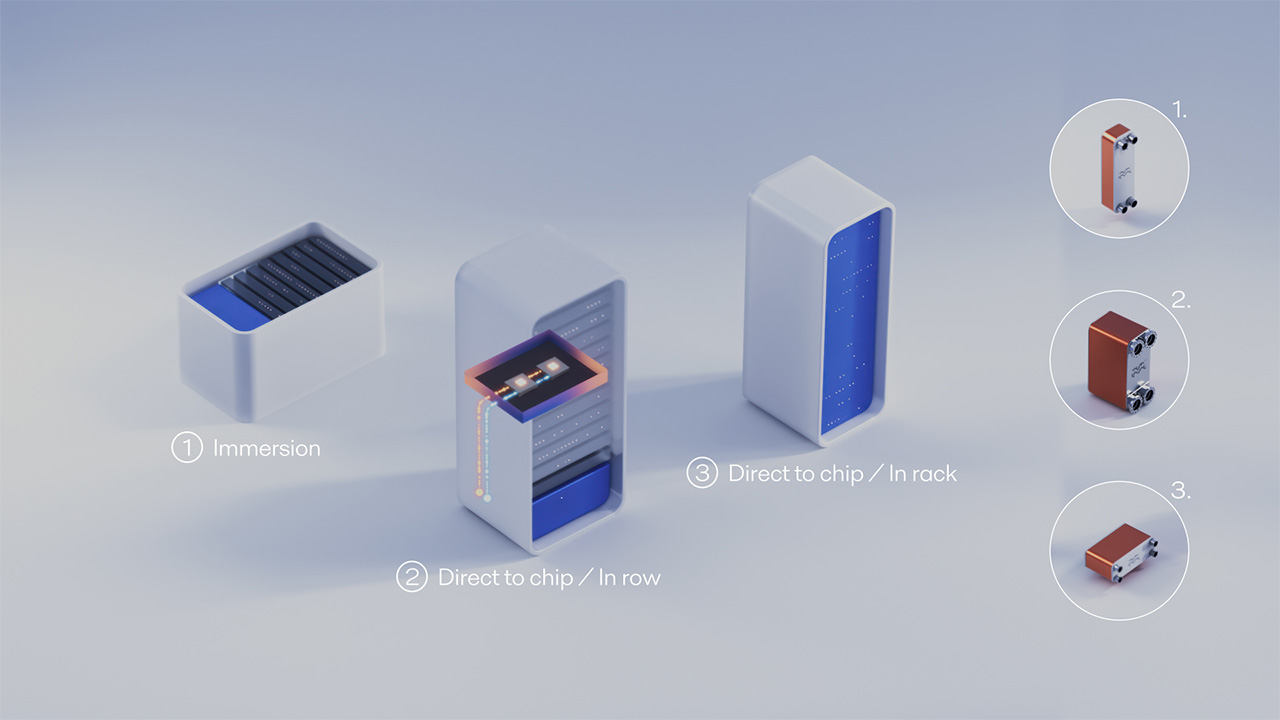
Direct-to-chip cooling works by circulating fluid through cold plates that sit directly on top of CPUs and GPUs. These plates pull heat away right at the source. The coolant then carries the heat to a Coolant Distribution Unit (CDU), keeping processors cool and systems reliable.
Comparing single-phase and two-phase direct-to-chip cooling
Single-phase direct-to-chip cooling
Coolant absorbs heat from the processor and returns to the CDU as a liquid to be cooled and recirculated.
- Moves heat away as liquid
- Handles moderate to high thermal loads
- Simplifies design and operation
Two-phase direct-to-chip cooling
Coolant changes from liquid to vapor as it absorbs heat, then condenses back to liquid at the CDU.
- Removes heat through phase change
- Manages extreme AI and HPC thermal loads
- Increases efficiency in dense racks
A competitive edge that starts with smarter cooling
Why do the best data centers trust Alfa Laval? Because we help them turn cooling into a strategic advantage.
With 140 years of innovation and millions of heat exchangers installed worldwide, our solutions are proven to cut energy costs and improve system reliability for critical IT infrastructure. With a global manufacturing footprint, scalable supply chain, and expert support at every step, our mission is to empower data centers with a strategic advantage for tomorrow.
Ready to switch to liquid cooling?
Let us guide your transition with advanced solutions that boost performance and equip your infrastructure to meet AI demands with confidence.
FAQs
Which hardware requirements matter before adopting direct-to-chip cooling?
Servers need compatible cold plates and approved coolant arrangements. Confirm processor, server and CDU requirements before planning deployment.
How does direct-to-chip cooling address concentrated GPU heat?
Cold plates capture heat directly at the processors. Coolant carries that heat to the CDU rather than relying only on room airflow.
When should single-phase direct-to-chip cooling be evaluated?
Evaluate it for compatible moderate-to-high thermal loads. Coolant remains liquid as it circulates between cold plates and the CDU.
What distinguishes two-phase direct-to-chip cooling at high loads?
The coolant absorbs heat through a change from liquid to vapor. It then condenses back to liquid for recirculation.
Does direct-to-chip cooling eliminate all room air cooling?
Not necessarily. Components outside the cold-plate circuit still need suitable cooling, so the remaining air load should be assessed.
Why does CDU heat exchanger pressure drop matter?
Pressure drop influences pumping requirements and available flow. Evaluate it alongside heat duty and the required coolant temperatures.
What limits the capacity of a direct-to-chip installation?
Cold plates, CDUs, facility piping and heat rejection all impose limits. Size the full cooling chain for peak processor loads.
How should fluid compatibility be addressed in the design?
Match the coolant with server requirements and all wetted materials. Confirm the selected heat exchanger's suitability for that fluid.
How does direct-to-chip cooling support future rack expansion?
It brings heat removal close to the processors. Expansion still depends on sufficient CDU capacity, facility flow and external heat rejection.
What information is needed for direct-to-chip cooling discussions?
Provide processor loads, coolant type, flow requirements and temperature limits. Include the server roadmap and facility loop conditions.