
Free cooling with air for smarter data center cooling
Harnessing outside air can reduce reliance on mechanical chillers and achieve low-impact cooling for cost-conscious data centers.
Free cooling with air is one of the best ways to reduce costs and environmental impact. It allows data centers to:
- Use zero water for cooling
- Significantly cut operating costs compared to chillers
- Reduce maintenance expenses
- Improve PUE with more efficient heat transfer
- Cut carbon emissions and support sustainability targets
Turning outside air into value
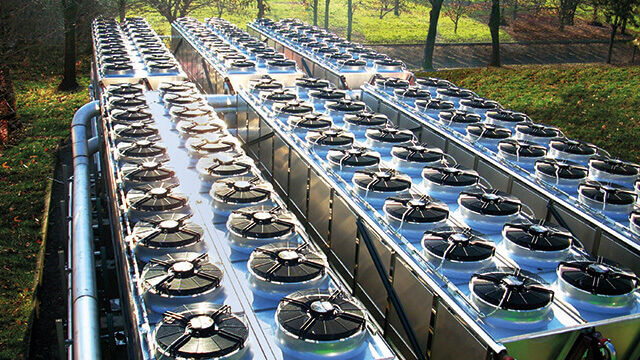
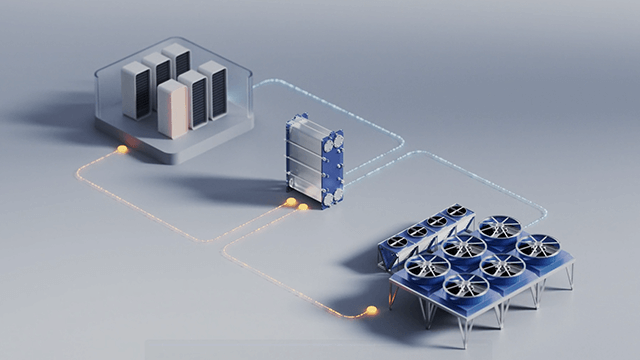
Free cooling with air uses naturally cold outside air to remove heat from a liquid cooling loop. Fans draw outside air across finned coils or tubes containing the heated liquid, allowing the air to absorb the heat. The cooled liquid is then recirculated back into the system, providing efficient cooling without the use of water or refrigerants.
Air cooling with and without a heat exchanger
Free cooling with air can be configured in different ways to maximize efficiency. Depending on your local climate, data centers may circulate the liquid cooling loop directly into the air cooler or use a heat exchanger to separate the cooling loop.
Cooling with a heat exchanger
In this setup, coolant absorbs heat from IT equipment and passes through a plate heat exchanger before reaching external air coolers. This thermal break separates internal and external loops, improving resilience, simplifying maintenance, and preventing contaminants from entering the data hall. The cooled fluid is then recirculated through the system.
- Maintains separation between outdoor air and IT equipment
- Reduces risk from dust, humidity, or pollutants
- Provides reliable performance across variable climates
Cooling without a heat exchanger
This configuration circulates coolant directly between IT equipment and external air coolers. The heated fluid is pumped outside, where ambient air passes over finned coils or tubes to dissipate heat before the fluid returns to the data center. With fewer components, this approach offers higher efficiency but depends on clean, stable air conditions for optimal operation.
- Delivers maximum efficiency with fewer components
- Lowers upfront and operating costs
- Best suited for clean, cool, and stable climates
Ready to unlock the power of free air cooling?
To lower energy consumption and reduce maintenance complexity, speak with our data center specialists to learn how Alfa Laval’s air cooler solutions can help you unlock long-term value through efficient, air-based heat rejection.
FAQs
When does free air cooling reduce mechanical chiller demand?
It reduces demand when outdoor air is cold enough for the required coolant temperatures. Available hours vary with site climate and system design.
Why would an air cooler use a separate heat exchanger?
The heat exchanger separates internal and external fluid circuits. This supports circuit protection and independent operating conditions.
When is direct circulation through an air cooler appropriate?
Evaluate direct circulation when fluid compatibility, temperature conditions and system protection requirements permit a shared loop.
Does the free air cooling arrangement consume water?
The described dry air cooler arrangement does not consume water for heat rejection. Confirm the complete site's design when evaluating total water use.
How should cooling capacity be assessed during hot weather?
Evaluate the air cooler at the site's design ambient temperature. Additional cooling is needed when ambient conditions do not meet the required duty.
What influences fan electricity in an air cooling installation?
Required airflow, thermal load and ambient temperature influence fan demand. Compare performance at both design and typical operating conditions.
Why should external and internal circuit temperatures be reviewed together?
The heat exchanger introduces a temperature approach between circuits. That difference affects the air cooler's usable capacity and operating hours.
How does free air cooling fit a liquid-cooled data center?
It rejects heat carried by the liquid loop outdoors. Liquid heat capture and air-based heat rejection work at different stages.
What maintenance requirements should be included in an air cooler proposal?
Include coil cleaning, fan servicing and access requirements. Local dust and environmental exposure affect maintenance planning.
Which site details help determine air cooling suitability?
Share ambient temperature data, heat duty, coolant limits and available space. Include noise requirements and the planned backup cooling arrangement.