
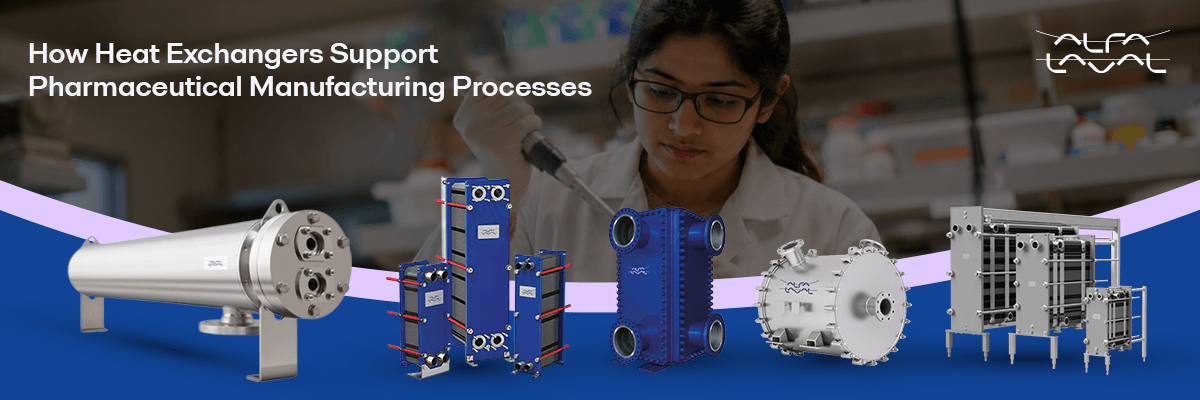
How Heat Exchangers Support Pharmaceutical Manufacturing
In the pharmaceutical manufacturing process, precise temperature control is critical to product quality, sterility, and patient safety. From API manufacturing to formulation and solvent recovery, maintaining stable thermal conditions supports efficient, compliant production. A trusted heat exchanger manufacturer helps ensure accurate temperature control in pharma through advanced pharma heat transfer systems, enabling consistent performance across every stage of manufacturing.
DATE 2026-07-03Importance of Heat Exchangers in the Pharmaceutical Industry
Why is precise thermal control critical?
Pharmaceutical processes involve sensitive reactions, complex formulations, and stringent hygiene requirements. Even a small temperature deviation can impact yield, efficacy, or stability. Heat exchangers in the pharmaceutical industry ensure that heating and cooling happen in a controlled, precise, repeatable way.
Impact on drug safety and compliance
Regulations such as GMP and FDA guidelines require strict control over thermal processing in pharmaceuticals. GMP compliant heat exchangers support validated processes, help maintain sterile conditions, and reduce the risk of cross‑contamination.
Energy efficiency and cost savings
Modern industrial heat exchangers for pharma improve heat recovery, reduce water and energy consumption, and lower operating costs – without compromising hygiene or safety. This balance is increasingly important for sustainable pharmaceutical production.
Key Applications of Heat Exchangers in Pharma Manufacturing
Heating and Cooling of Process Fluids
Pharmaceutical fluid heating and cooling is required for solvents, water, intermediates, and finished products. Plate and tubular heat exchangers ensure uniform temperature control while protecting heat‑sensitive compounds throughout the process.
Applications include:
- Heating reaction media
- Cooling intermediates before downstream processing
- Temperature control in formulation vessels
Sterilization and Pasteurization
Sterility is non‑negotiable. Sterilization heat exchangers support processes such as clean‑steam generation, hot‑water circulation, and thermal disinfection. CIP SIP heat exchangers are specifically designed to tolerate repeated cleaning and sterilization cycles.
Condensation and Evaporation
Distillation, evaporation, and condensation are essential for solvent recovery systems in pharma. Heat exchangers make it possible to condense vapours efficiently while maintaining high recovery rates and reducing emissions.
Heat Exchangers in API Manufacturing
Role in Active Pharmaceutical Ingredient (API) Production
An API manufacturing heat exchanger plays a vital role in maintaining reaction temperatures, controlling exothermic processes, and handling aggressive or corrosive media. Consistent thermal performance helps manufacturers protect product quality and improve yields.
In API plants, heat exchangers must also handle:
- High pressures and temperatures
- Solvent‑rich environments
- Vacuum and condensation duties
Compabloc Heat Exchangers for API Processing
Compabloc heat exchanger pharma solutions are well suited for demanding API processes. Their compact, fully welded design delivers high heat‑transfer efficiency while minimizing hold‑up volume.
Key advantages include:
- Reliable performance with aggressive chemicals
- Easy cleaning and inspection
- Efficient condensation for solvent recovery
These characteristics make them a preferred heat exchanger for API plants where space, hygiene, and efficiency all matter.
Spiral Heat Exchangers in API Plants
A spiral heat exchanger for chemicals is often chosen for fouling or viscous process streams. The single‑channel design promotes continuous self‑cleaning and stable heat transfer.
In API manufacturing, spiral heat exchangers support:
- Continuous processing
- Reduced fouling and downtime
- Reliable handling of challenging fluids
Heat Exchangers in Pharmaceutical Formulation
Importance in Drug Formulation
During formulation, maintaining consistent temperature is essential for mixing, blending, emulsification, and dissolution. A well‑designed formulation process heat exchanger ensures uniform product quality batch after batch.
Hygienic Line Heat Exchangers
Hygienic heat exchanger pharma solutions are designed specifically for sterile and clean environments. Constructed from stainless steel and engineered for smooth surfaces, sanitary heat exchangers support high‑purity processes.
Key features include:
- Compatibility with CIP and SIP
- Easy cleaning and full drainability
- Designs suited for validated environments
Ensuring Product Integrity and Safety
By maintaining uniform temperature and preventing contamination, hygienic heat exchangers help protect formulation integrity, ensuring patient safety and regulatory compliance.
Types of Heat Exchangers Used in the Pharma Industry by Alfa Laval
Pharmaceutical manufacturers typically rely on several types of heat exchangers in pharma, depending on the application:
Shell & tube heat exchangers - For robust and flexible for hygienic duties
Plate heat exchangers - Compact and energy‑efficient
Compabloc heat exchangers - Ideal for API condensation and aggressive media
Spiral heat exchangers - Suited for fouling and viscous fluids
Hygienic Line heat exchangers - Designed for sterile, GMP environments
Selecting the right technology is where an experienced heat exchanger manufacturer adds real value.
Types of Heat Exchangers and Their Pharmaceutical Applications
|
Process |
Heat Exchanger |
Primary Benefit |
|
API Manufacturing |
Compabloc |
High thermal efficiency |
|
Solvent Recovery |
Compabloc |
Efficient condensation |
|
Formulation |
Hygienic Line |
Sterile operation |
|
Fermentation |
Plate Heat Exchanger |
Precise temperature control |
|
Viscous Fluids |
Spiral |
Reduced fouling |
Benefits of Using Heat Exchangers in Pharmaceutical Processes
The benefits of heat exchangers extend across the entire pharmaceutical value chain:
- Improved product quality and consistency
- Reliable temperature control and sterility
- Energy‑efficient and sustainable operation
- Reduced operational and maintenance costs
- Easier GMP compliance and validation
- Scalability from pilot to commercial production
Key Factors to Consider When Selecting a Heat Exchanger
When choosing a heat exchanger for pharmaceutical use, manufacturers should consider:
- Material compatibility with process fluids
- Cleanability, including CIP/SIP capability
- Pressure and temperature limits
- Regulatory compliance, including GMP standards
- Long‑term reliability and service support
Working with a trusted heat exchanger manufacturer helps ensure these requirements are met from design to operation.
Future Trends in Pharma Heat Exchange Technology
Pharmaceutical heat transfer continues to evolve. Key trends include:
- Smart monitoring and automation for predictive maintenance
- More energy‑efficient and compact designs
- Advanced materials and surface treatments
- Increased focus on sustainability and heat recovery
These innovations are shaping the next generation of pharma heat transfer systems.
Heat exchangers play a critical role throughout pharmaceutical manufacturing, from API production to final formulation. They support precise temperature control, hygienic operation, and regulatory compliance while improving efficiency and sustainability.
By partnering with an experienced heat exchanger manufacturer, pharmaceutical companies can ensure reliable thermal performance across the entire manufacturing process – helping deliver safe, high‑quality medicines to patients worldwide.
Key Takeaways
- Heat exchangers are critical for precise temperature control throughout pharmaceutical manufacturing.
- They help ensure product quality, sterility, and patient safety.
- Heat exchangers support GMP compliance and validated pharmaceutical processes.
- Key applications include heating, cooling, sterilization, and solvent recovery.
- API manufacturing relies on efficient heat exchangers for stable reaction control.
- Compabloc heat exchangers offer high efficiency for API processing and solvent recovery.
- Spiral heat exchangers reduce fouling and improve performance with challenging fluids.
- Hygienic heat exchangers help maintain sterile conditions during formulation.
- Modern heat exchangers improve energy efficiency and reduce operating costs.
- Selecting the right heat exchanger technology enhances reliability, compliance, and production efficiency.
FAQs
Why are heat exchangers important in pharmaceutical manufacturing?
They enable precise temperature control, support sterility, improve efficiency, and ensure compliance with GMP requirements throughout the pharmaceutical manufacturing process.
What type of heat exchanger is best for API production?
Compabloc and spiral heat exchangers are commonly used in API plants due to their efficiency, robustness, and ability to handle aggressive media.
What is a hygienic heat exchanger?
A hygienic heat exchanger is designed for clean, sterile operation, with smooth surfaces and CIP/SIP compatibility to prevent contamination.
How do Compabloc heat exchangers benefit pharma processes?
They offer compact design, high thermal efficiency, and excellent performance in solvent recovery and API processing environments.
What is the role of spiral heat exchangers in pharma?
Spiral heat exchangers handle fouling and viscous fluids effectively, supporting continuous and reliable processing in API manufacturing.