
Decanter Centrifuge in Wastewater Treatment: Role in ETP & STP Plants
India’s industries and cities generate more wastewater than ever, while water grows scarcer and discharge norms tighten. Sludge —not water — now drives treatment cost. Efficient sludge management is now core plant economics. That is why the decanter centrifuge in wastewater treatment has become central to modern ETP and STP design, turning wet sludge into dry, transportable cake and recoverable water. Choosing the right decanter centrifuge manufacturer is now a decade-long financial decision.
DATE 2026-09-17What is a Decanter Centrifuge?
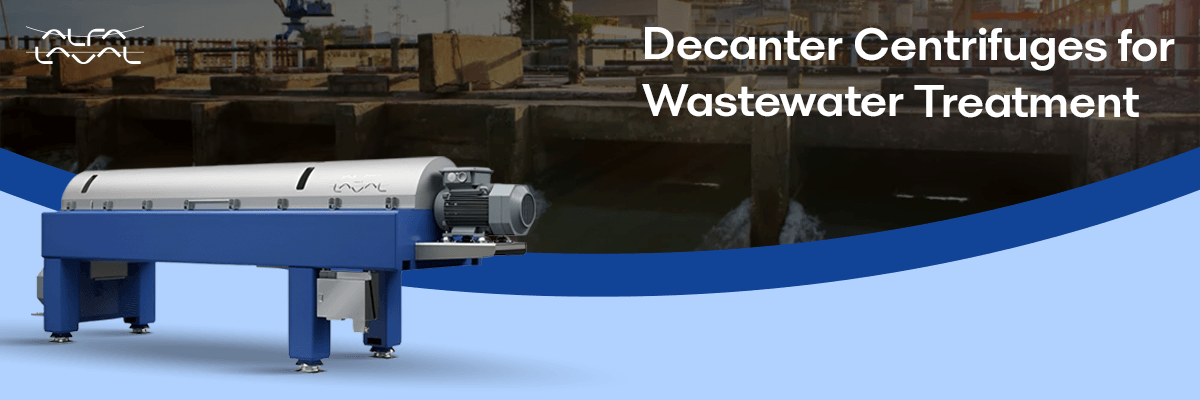
A decanter centrifuge is continuous solid-liquid separation equipment that uses centrifugal force to separate suspended solids from a liquid stream. Alfa Laval’s Aldec & i-Dec range is built around cost-effectiveness, reliability and easy operation, and is used to thicken and dewater sludge from municipal, industrial and potable water treatment plants (Aldec decanter centrifuges).
Because it runs continuously with minimal operator intervention, it has become the default high-volume wastewater treatment equipment in both ETP and STP applications. The decanter centrifuge in wastewater treatment therefore sits at the exact intersection of compliance and cost control — which is why the choice of decanter centrifuge manufacturer matters as much as the choice of technology.
Decanter Centrifuge Working Principle
The decanter centrifuge working principle is best understood as a settling pond wrapped around an axis.
Separation takes place in a horizontal cylindrical bowl fitted with a screw conveyor. Sludge enters through a stationary inlet tube and is accelerated smoothly by an inlet distributor. The centrifugal force resulting from rotation causes sedimentation of the solids on the wall of the bowl. The conveyor rotates in the same direction as the bowl but slightly slower, moving the settled solids towards the conical end, where they are lifted clear of the liquid pond, drained and discharged as cake. Clarified liquid — the centrate — flows out at the opposite end through adjustable outlet dams.
Separation occurs throughout the entire length of the cylindrical part of the bowl, which is why throughput is high and retention time is used efficiently. Alfa Laval decanters can be adjusted to suit individual requirements by varying bowl speed, conveying speed, pond depth and feed flow. This tunability is exactly why the decanter centrifuge in wastewater treatment copes with feed variability that would defeat fixed-geometry equipment, and a capable decanter centrifuge manufacturer will configure these settings around your sludge rather than a generic curve.
Key Components of a Decanter Centrifuge
- Rotating bowl — cylindrical-conical shell, stainless steel as standard
- Screw conveyor — concentrically suspended, moving solids to the conical end
- Feed inlet — the FeedProtect zone ensures gentle acceleration and low turbulence
- Discharge outlets — SolidsProtect, a 360° outlet design for even, blockage-free solids discharge, plus adjustable liquid outlets
Wear protection is where a specialist decanter centrifuge manufacturer earns its keep. Alfa Laval offers FlightProtect coating and FlightGuard tungsten-carbide tiles for abrasive duties, plus the patented EasyLift hinged cover for safe, fast service access.
Review continuous separation technology for wastewater applications.
Explore Alfa Laval’s decanter centrifuge range
Importance of Wastewater Treatment in Modern Industries and Cities
Three forces are converging on Indian plants at once.
Environmental compliance. Tightening effluent norms and Zero Liquid Discharge mandates for water-intensive sectors have moved treatment from a licence condition to an operational discipline.
Water reuse and sustainability. Water is now a public ESG KPI. Plants must document and reduce their water footprint, and poor waste management is a direct financial risk in water-stressed regions.
Rising sludge generation. Better treatment produces more sludge, and every tonne carries transport, handling and disposal cost. Robust sludge management systems built around a decanter centrifuge in wastewater treatment attack that cost centre directly — the essence of modern industrial wastewater treatment solutions.
Role of Decanter Centrifuges in Wastewater Treatment
Sludge Dewatering Process
The sludge dewatering process is where a decanter delivers its clearest commercial return. Sludge arriving from the treatment line is largely water, and it is that water — not the solids — that fills tankers, drives up tipping fees and inflates handling costs.
By removing the bulk of the free water and converting a thin, pumpable slurry into a firm, stackable cake, the decanter dramatically shrinks the volume that has to leave the site. Fewer truck movements, less storage, lower disposal charges and reduced downstream emissions follow directly. The cake is easier and safer to handle, easier to store, and better suited to onward routes such as composting, co-processing, incineration or landfill.
Just as importantly, the process is repeatable. Once configured for a given sludge, the machine delivers a consistent cake and a consistently clear centrate that can be returned upstream without upsetting the biology. That predictability is what allows plant managers to budget disposal costs with confidence — and it is the single strongest reason the decanter centrifuge in wastewater treatment has become standard equipment in both ETP and STP sludge lines (sludge treatment overview).
Continuous and Automated Operation
Decanters run without interruption. Variable frequency drives control both bowl and conveyor speed, and auto control mode allows the differential speed to modulate while holding torque constant — the machine self-optimises as feed conditions change. Touchscreen HMIs, automatic flush routines, service reminders and SCADA connectivity mean operators manage exceptions, not the process, cutting manual labour sharply compared with batch technologies.
High Separation Efficiency
Feed quality changes daily; batch chemistry shifts, biomass fluctuates, monsoon dilutes influent, and industrial estates receive mixed effluent from many tenants. Alfa Laval’s DeepPond configuration extends retention time inside the bowl for improved separation, while cone geometry and conveyor design are matched to the sludge type. An experienced decanter centrifuge manufacturer selects these based on whether the sludge is primary, biological, mixed, digested or chemical.
Applications in Effluent Treatment Plants (ETP)
What is an ETP Plant?
An Effluent Treatment Plant treats industrial wastewater before discharge or reuse. The ETP plant process combines physico-chemical stages, biological treatment, tertiary polishing and a sludge handling line, removing harmful chemicals, oils and suspended contaminants.
Use of Decanter Centrifuges in ETP
Within effluent treatment plant machinery, the decanter handles:
- Chemical and biological sludge dewatering from coagulation, flocculation and DAF units
- Oil, water and solids separation — including the patented Alfa Laval Oil Plus range for free-oil recovery
- Hazardous industrial waste, where a drier cake means less tonnage at hazardous disposal rates
- ZLD crystalliser slurries, dewatering precipitated salts downstream of evaporators
An industrial decanter centrifuge in duplex or super-duplex steel handles corrosive, high-chloride, high-temperature feeds that would destroy standard stainless equipment. The breadth of decanter centrifuge applications across these duties is why a proven decanter centrifuge manufacturer is worth specifying.
Industries Using ETP Centrifuges
- Chemical, petrochemical and pharmaceutical plants
- Textile, dyeing and paper units
- Food, beverage, dairy, brewery, starch and distillery processing plants
- Protein and fish processing, sugar, ethanol, biogas and CBG plants
Typical industrial centrifuge uses here extend beyond effluent into product recovery — recovering technical oil or valuable fractions that become an additional revenue stream.
Applications in Sewage Treatment Plants (STP)
What is an STP Plant?
A Sewage Treatment Plant treats municipal sewage and domestic wastewater. STP plant working runs from screening and grit removal through primary sedimentation and biological treatment to tertiary polishing and a sludge line of thickening, digestion and dewatering.
Role of Decanter Centrifuge in STP
- Thickening of primary and waste activated sludge ahead of digestion, reducing digester volume and heating load
- Dewatering of digested and mixed sludge into transportable cake
- Moisture reduction, which directly shrinks disposal tonnage
For sewage treatment plant sludge handling, footprint is decisive — the compact modular design delivers high capacity in a small space, and the fully enclosed casing contains odour, a real advantage for plants near residential areas.
Benefits in Urban Wastewater Management
Real installations prove the case. Aldec G3 units at Sydney Water’s Cronulla plant cut electricity use by 47% and CO₂ by 173 tonnes per year, while Horsens WWTP in Denmark saved over €100,000 per year on sludge disposal.
Plan sludge dewatering around your municipal treatment goals.
Review Alfa Laval’s municipal wastewater treatment solutions
Advantages of Using Decanter Centrifuges in ETP & STP
- Reduced sludge volume, cutting transport and disposal costs
- Compact, modular design giving high processing capacity in a small footprint
- Continuous, automated operation with minimal manpower
- High performance with low energy consumption — the Aldec G3 design reduces total power consumption by as much as 40%
- Enclosed, hygienic sludge handling with fast serviceability
Deploying a decanter centrifuge in wastewater treatment is therefore both a compliance move and a cost-reduction move.
Decanter Centrifuge vs Traditional Sludge Dewatering Methods
Compared with older wastewater sludge treatment methods, decanter centrifuges operate continuously rather than in batches, occupy far less space, offer higher automation and repeatable performance, run fully enclosed for odour control, and scale cleanly for large municipal and industrial duties. Alfa Laval’s own retrofit projects — replacing ageing belt presses with Aldec G3 machines — have delivered drier cake, cleaner centrate and lower chemical and energy use, with payback in around two years. This is why the decanter centrifuge in wastewater treatment continues to displace legacy technologies.
Factors to Consider When Choosing a Decanter Centrifuge
- Nature of the sludge — industrial or municipal, biological or chemical, abrasive or benign
- Required capacity and throughput, with headroom for peak and future flows
- Energy efficiency — drive design and outlet configuration materially affect power draw
- Materials and wear protection appropriate to corrosivity and abrasiveness
- Maintenance and service — spare-part availability, service agreements and local field engineers
Ask any prospective decanter centrifuge manufacturer for spin-test or pilot data on your own sludge; Alfa Laval provides laboratory spin tests and rental test machines for exactly this. The best decanter centrifuge manufacturer partners prove performance before you commit capital. When comparing wastewater treatment companies in India, weigh local service depth as heavily as machine price — uptime is where the money actually is.
Compare treatment options for industrial effluent and resource recovery.
Explore Alfa Laval’s industrial water and waste treatment solutions
Future Trends in Wastewater Treatment
Expect smarter, more automated systems with adaptive polymer and feed control becoming standard. Connected decanters already stream operating data through IoT hardware for remote support and condition monitoring, with bearing-condition alerts converting unplanned stops into scheduled work. And the focus on energy-efficient, sustainable design continues — with sludge increasingly treated as a resource for biogas, fertiliser or energy recovery. The decanter centrifuge in wastewater treatment is becoming a connected, data-driven asset, and the right decanter centrifuge manufacturer will bring that digital layer with the hardware.
Decanter centrifuges are now essential to modern wastewater management. In both ETP and STP plants they compress sludge volumes, cut disposal costs, run continuously with minimal labour and help operators meet increasingly strict discharge norms. Whether the goal is efficiency, compliance or sustainability, the decanter centrifuge in wastewater treatment delivers.
Alfa Laval is a global decanter centrifuge manufacturer with over 140 years of separation heritage, more than 85 years in India and a dedicated decanter manufacturing facility in Pune — explore our decanter centrifuge range and industrial water and waste treatment solutions.
Key Takeaways
- Decanter centrifuges play a vital role in modern wastewater treatment, enabling efficient solid-liquid separation in both ETPs and STPs.
- They significantly reduce sludge volume, helping lower transportation, handling, and disposal costs.
- Continuous and automated operation minimizes manual intervention while ensuring consistent performance and reliability.
- In ETPs, decanter centrifuges are used for chemical and biological sludge dewatering, oil-water-solid separation, and hazardous waste management.
- In STPs, they support sludge thickening, dewatering, and moisture reduction, improving overall treatment efficiency.
- Compared to traditional dewatering methods, decanter centrifuges offer higher automation, a smaller footprint, better odor control, and more consistent results.
- Selecting the right centrifuge requires evaluating sludge characteristics, throughput requirements, energy efficiency, material construction, wear protection, and service support.
- Advanced capabilities such as IoT-enabled monitoring, automated controls, and energy-efficient designs are driving the next generation of wastewater treatment systems.
- Decanter centrifuges help organizations achieve regulatory compliance, sustainability objectives, and long-term operational savings.
- Partnering with an experienced manufacturer ensures optimal performance, higher uptime, and a stronger return on investment.
FAQs
What is the use of a decanter centrifuge in wastewater treatment?
It separates solids from liquid continuously using centrifugal force, thickening and dewatering sludge so that volume, transport and disposal costs fall sharply.
How does a decanter centrifuge work in an ETP plant?
It receives chemical or biological sludge, settles the solids against the bowl wall, scrolls them to the conical end as cake, and returns clarified centrate upstream for further treatment or reuse.
Why is sludge dewatering important in STP plants?
Because disposal cost scales with volume. Removing water reduces tonnage, cuts transport and landfill charges, and improves overall plant efficiency.
What industries use decanter centrifuges?
Municipal sewage and potable water utilities, plus chemical, pharmaceutical, textile, paper, food and beverage, dairy, distillery, biogas, sugar, mining and minerals.
What are the advantages of decanter centrifuges over traditional methods?
Continuous automated operation, a compact footprint, enclosed odour control, consistent output quality and lower lifetime operating cost.
Can decanter centrifuges handle industrial sludge?
Yes. With the right materials, wear protection and configuration from a specialist decanter centrifuge manufacturer, an industrial decanter centrifuge handles abrasive, corrosive and highly variable industrial sludges reliably.
Author
Poonam Pandey
Poonam Pandey is a Business Manager - Water & Wastewater, based in Pune, India, with 15+ years of experience in Water Industry. She works closely with sales, process & application, and customers to deliver optimized solutions, finalize technical specifications, while ensuring alignment with commercial terms.