
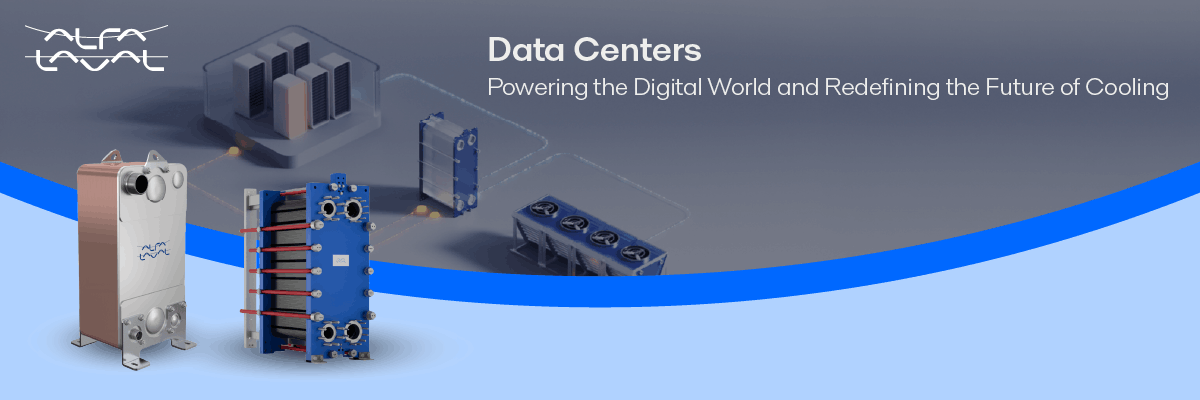
Data Centers: Powering the Digital World and Redefining the Future of Cooling
From online banking and digital payments to streaming, cloud services, and AI, most digital experiences rely on data centers. These facilities power essential services for individuals, businesses, and governments. As data demand grows, the industry is scaling rapidly, creating challenges around energy use, thermal efficiency, and sustainability. Advanced cooling solutions, including brazed plate heat exchanger and gasketed plate heat exchanger technology, help meet these evolving needs.
DATE 2026-09-03Why Data Centers Matter More Than Ever
Data centers are no longer just storage and server facilities. They are strategic infrastructure supporting a rapidly digitizing economy. As data usage grows and applications become more compute-intensive, organizations need data centers that are not only reliable and scalable, but also efficient and future-ready.
The growth drivers are clear:
- Increasing adoption of cloud services
- Rapid expansion of AI and high-performance computing
- Greater use of digital platforms across industries
- Rising focus on data sovereignty and regional infrastructure
- Demand for lower latency and faster digital experiences
This is especially visible in fast-growing markets like India, where investment in digital infrastructure is accelerating across hyperscale, colocation, enterprise, and edge data centers.
A New Era of Data Center Design
As data centers evolve, so do their technical requirements. One of the biggest shifts underway is the rise in rack power density. Traditional air-cooling methods, while effective for earlier generations of data centers, are increasingly being challenged by high-density computing environments.
This is driving a major transition:
From Air Cooling to Liquid Cooling
As computing loads intensify, liquid cooling is emerging as a practical and efficient solution for managing higher thermal loads. It helps remove heat more effectively, supports compact high-performance systems, and can contribute to lower overall energy consumption when designed well. At the core of most liquid cooling loops sits a brazed plate heat exchanger, valued for its compact size, high thermal efficiency, and reliable performance under continuous operation.
This shift is not just a technology change; it is a design transformation for the entire data center ecosystem.
See the technology behind liquid cooling
Explore Alfa Laval's range of brazed plate heat exchangers built for high-density, high-efficiency data center cooling.
View Brazed Plate Heat Exchangers
Efficiency Is Now a Business Priority
Energy efficiency has become one of the most important performance indicators for data centers. Operators are working to improve infrastructure performance while minimizing waste, operating cost, and environmental impact.
A central metric in this journey is Power Usage Effectiveness (PUE), which reflects how efficiently a facility uses energy. Lower PUE values indicate that more of the energy consumed is going directly to IT equipment rather than to supporting systems such as cooling.
Improving PUE is no longer optional. It is essential for:
- Controlling energy costs
- Meeting sustainability targets
- Supporting higher compute densities
- Building resilient long-term operations
Sustainability Is Shaping the Next Generation of Facilities
The future of data centers is not only digital, it must also be sustainable. Cooling and water usage are receiving growing attention as operators seek ways to reduce environmental impact without compromising performance.
Several approaches are gaining traction:
- Reuse of treated municipal wastewater in cooling systems
- Free cooling where climate conditions allow
- Heat reuse opportunities
- Alternative cooling media such as seawater or lake water
- Smarter system optimization and control strategies
These trends reflect a broader shift in the industry: from building data centers that simply operate, to building data centers that operate responsibly.
Alfa Laval's Role in the Data Center Opportunity
As the industry advances, Alfa Laval has an important role to play in enabling efficient and sustainable data center infrastructure. With strong capabilities in heat transfer, cooling systems, and energy optimization, Alfa Laval supports the sector through solutions that help customers:
- Improve cooling performance
- Reduce energy consumption
- Lower CO2 footprint
- Enhance operational reliability
- Support more sustainable water and thermal management strategies
From heat exchangers and cooling distribution solutions to service and lifecycle support, Alfa Laval is well positioned to contribute across multiple parts of the data center value chain.
Brazed Plate Heat Exchangers for Data Center Cooling
As one of the leading brazed plate heat exchanger manufacturers in India, Alfa Laval engineers compact, permanently brazed units that handle high thermal loads in a small footprint, making them well suited to space-constrained data center cooling rooms and liquid cooling loops.
Gasketed Plate and Frame Heat Exchangers for Data Center Cooling
For applications that call for serviceability, flexibility, and scalability, such as central plant cooling and free-cooling loops, a gasketed plate and frame heat exchanger allows plates to be added, removed, or cleaned as capacity needs change, without replacing the entire unit. This makes gasketed plate heat exchanger technology a practical choice for data centers planning phased or long-term capacity growth.
Need a scalable, serviceable cooling solution?
See how Alfa Laval's gasketed plate and frame heat exchangers support flexible, long-term data center cooling.
View Gasketed Plate and Frame Heat Exchangers
A Growing Opportunity Ahead
Data centers represent more than an infrastructure trend, they are a long-term growth opportunity. Across segments such as colocation, hyperscale, and enterprise, demand continues to expand, creating space for both technology innovation and strategic partnerships.
For companies that can combine reliability, efficiency, and sustainability, the opportunity is significant.
Data centers are shaping the future of the digital economy, and the future of data centers will be shaped by smarter cooling, better efficiency, and more sustainable infrastructure.
Talk to Alfa Laval about your data center cooling needs
Connect with our team to find the right brazed or gasketed plate heat exchanger for your facility.
Contact Us
Key Takeaways
- Data centers are the foundation of today's digital economy, powering cloud, AI, banking, and online services.
- Growing cloud adoption and AI workloads are driving unprecedented demand for data center infrastructure.
- India is witnessing rapid expansion of hyperscale, colocation, enterprise, and edge data centers.
- Increasing rack power densities are pushing data centers beyond the limits of traditional air cooling.
- Liquid cooling is emerging as the preferred solution for managing high-performance computing environments.
- Brazed Plate Heat Exchangers (BPHEs) enable efficient heat transfer in compact, high-density cooling systems.
- Energy efficiency and low Power Usage Effectiveness (PUE) have become critical business priorities for operators.
- Sustainable practices such as free cooling, wastewater reuse, and heat recovery are gaining momentum across the industry.
- Gasketed Plate Heat Exchangers offer flexibility, scalability, and easy maintenance for evolving cooling requirements.
- The future of data centers will be defined by smarter cooling, higher efficiency, and sustainable infrastructure solutions.
FAQs
What is a brazed plate heat exchanger and how is it used in data center cooling?
A brazed plate heat exchanger is a compact, permanently sealed heat transfer unit made of stainless steel plates fused together, typically with copper or nickel brazing. In data centers, it is used to transfer heat efficiently between coolant loops, such as between a liquid cooling loop and the facility's chilled water system, in a small footprint.
What is the difference between a brazed plate heat exchanger and a gasketed plate heat exchanger?
A brazed plate heat exchanger is permanently sealed and cannot be opened, making it compact and leak-resistant but not field-serviceable. A gasketed plate heat exchanger uses gaskets to hold plates together, so it can be opened for cleaning, inspection, or capacity changes by adding or removing plates. Data centers often choose brazed units for compact, high-pressure duty and gasketed plate and frame heat exchangers where serviceability and future scalability matter.
Who are the leading brazed plate heat exchanger manufacturers in India?
India's data center and industrial cooling sectors rely on established brazed plate heat exchanger manufacturers with proven engineering and local service support. Alfa Laval is among the brazed plate heat exchanger manufacturers in India offering solutions engineered for high-density cooling loads, along with lifecycle service and support.
How does liquid cooling improve data center energy efficiency (PUE)?
Liquid cooling removes heat more effectively than traditional air cooling, which allows data centers to support higher rack densities while using less energy on supporting cooling infrastructure. This directly improves Power Usage Effectiveness (PUE) by shifting more of the facility's total energy use toward IT equipment rather than cooling overhead.
Why choose Alfa Laval as a plate heat exchanger manufacturer for data centers?
Alfa Laval combines deep heat transfer expertise with a broad range of brazed plate heat exchanger and gasketed plate and frame heat exchanger solutions, backed by service and lifecycle support across India. This makes it possible to match the right heat exchanger technology to a facility's cooling loads, space constraints, and long-term scalability needs.