Geothermal heating
Geothermal energy can come in different shapes; deep or shallow, high or lower temperature and be used for electricity or heat generation - but have always in common that it is available 24/7. Because it comes from the earth’s crust it is a renewable source that is not dependent on weather or season. Apart from heating, an aquifer storage system can also be used to deliver free cooling to a building.
Choose the right Geothermal Energy partner
- At Alfa Laval, we see the great potential in geothermal energy being an important sustainable heating resource for the future.
- Our goal is to supply energy efficient and reliable solutions that facilitate the highest possible yield at the lowest cost to the environment.
- With nearly 100 years of heat transfer experience and service centers all over the world, We have experience and local presence in all the markets.
- We know which heat exchanger will best optimize your production with the lowest possible payback time.
- With AHRI third party performance certification, you can rest easy that the thermal performance of our products is as good as we say it is.
Trends in geothermal heating industry
Focus on geothermal energy as an alternative to traditional fossil fuels is on the rise in the heating sector. Especially where it can replace fuels in district heating networks and reach a large number of customers from one single set of wells. There is also a growing experience for use of shallow geothermal with lower available temperature and aquifer thermal storage systems together with heat pumps to form a affordable and energy efficient options on the renewable energy market.
However, this industry doesn’t come without challenges. As the water can contain high levels of chloride and other impurities, scaling and fouling can build up and reduce the performance of process equipment. That is where we come in. Alfa Laval’s high-quality equipment and experience in the field of service are proven to keep your processes at optimum capacity with minimal downtime.
The Netherlands is the world’s second-largest food exporter by value, and the country’s 9000 hectares of greenhouses are a big reason why. But keeping those greenhouses at the right temperature requires lots of energy, so developing alternative energy sources is a top priority in the country’s efforts to meet its ambitious climate targets.
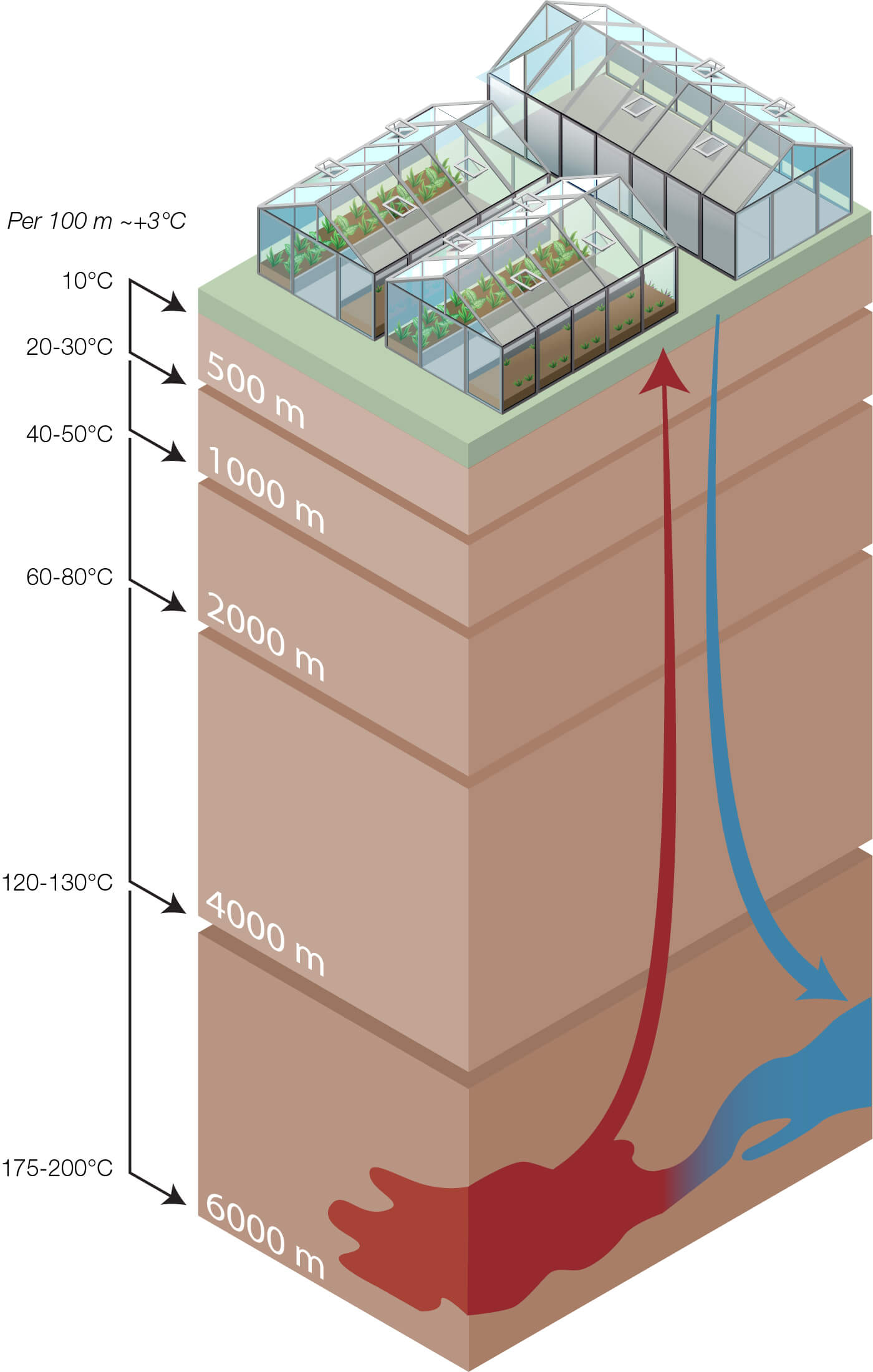
In many cases, geothermal plants that pump water from depths of at least 500 meters are the answer. Once drawn and used, this water can then be returned to the earth in an injection well.
Find out more about the important role of the heat exchanger in this revolutionary process.
Difference between shallow, aquifer and deep geothermal
Every well is unique with depths changing depending on location and conditions. When this industry talks about shallow or deep wells it is really to identify the main characteristics of a project. Shallow geothermal heat is generated from subsurface water using either an open loop where water is pumped from the well or a closed loop system with brine in a collector loop which is pumped up and down in the well.
Shallow wells and aquifers (≤500m)
Shallow geothermal heating using ATES (aquifer thermal energy storage) typically operates at depths of up to 100 meters where a heat pump is needed to achieve the right temperatures for heating purposes.
For cooling, shallow wells are an excellent source for free cooling, as water can be used at an ambient temperature to cool buildings during hot weather.
Shallow geothermal systems are most popular in residential and small commercial buildings, as they can be installed in a relatively small space and require less drilling and excavation than deep geothermal systems.
Deep wells (2000 - 5000m)
Deep geothermal heating typically operates at depths ranging from about five hundred meters to several kilometers below the surface where hot water or steam are used to generate via a heat exchanger.
The temperature of deep geothermal wells is often high enough to be used directly as it is, but at some locations and depths, there is still a need for heat pumps.
The most common depths for deep geothermal systems used for delivering heating to buildings and greenhouses are between 1,500 and 3,000 meters. It is often then connected directly to district heating systems.
Products
Gasketed plate-and-frame heat exchangers
- Flexible solutions that can be adapted to the duty ensuring highest thermal efficiency
- Compact designs save space and are easy to service and maintain
- Solutions to reduce fouling, stress and corrosion for maximum uptime
Brazed plate heat exchangers
- Lightweight copper-brazed construction with compact footprint
- Greater thermal efficiency than comparable shell-and-tubes
- Flexible options to fit a variety of applications with all different types of media/fluids
- Ideal for natural and low-GWP refrigerants
Fusion bonded AlfaNova heat exchangers
- True 100% stainless steel construction
- Strong corrosion resistance with aggressive media
- Prevents metal contamination in drinking water and other hygienic applications
- High thermal efficiency and compact footprint
Case story

When it comes to equipment, we simply have to pick the best. The supplier must be able to prove a powerful capacity for after sales services and emergency preparedness. We are happy to say, that Alfa Laval fulfils these uncompromising criteria with a very safe margin.
Ali Ichedef, General Manager of Izmir Jeotermal
Efficiency that lasts for decades
The condition of your heat exchanger affects safety, product quality, and energy costs. Failures lead to downtime and production losses. But, with regular and proactive maintenance, performance is preserved and operations are kept trouble-free and predictable.
We have the expertise to help you, whether you experience a problem today, wish to prevent future issues, or want to solve the problem yourself with our online troubleshooter.
HVAC and the Sustainable cities
Consuming more than two-thirds of the world’s energy, our cities play a crucial role in tackling the climate crisis. A considerable part of cities’ energy consumption is for heating and cooling, which means improving energy efficiency is paramount. Alfa Laval has almost a century of experience in heat transfer and recovery and aims to become carbon neutral by 2030. Let us be your partner in the transformation to a sustainable tomorrow.